Case study · Industry & Manufacturing
The robot takes the dangerous steps. The operator stays in command.
End-of-life appliances are dismantled by hand — hazardous, repetitive work on units that are never twice the same. With SUEZ, we built a human-robot cell that changes who does the dangerous part, starting with microwave ovens.
Inside the cell
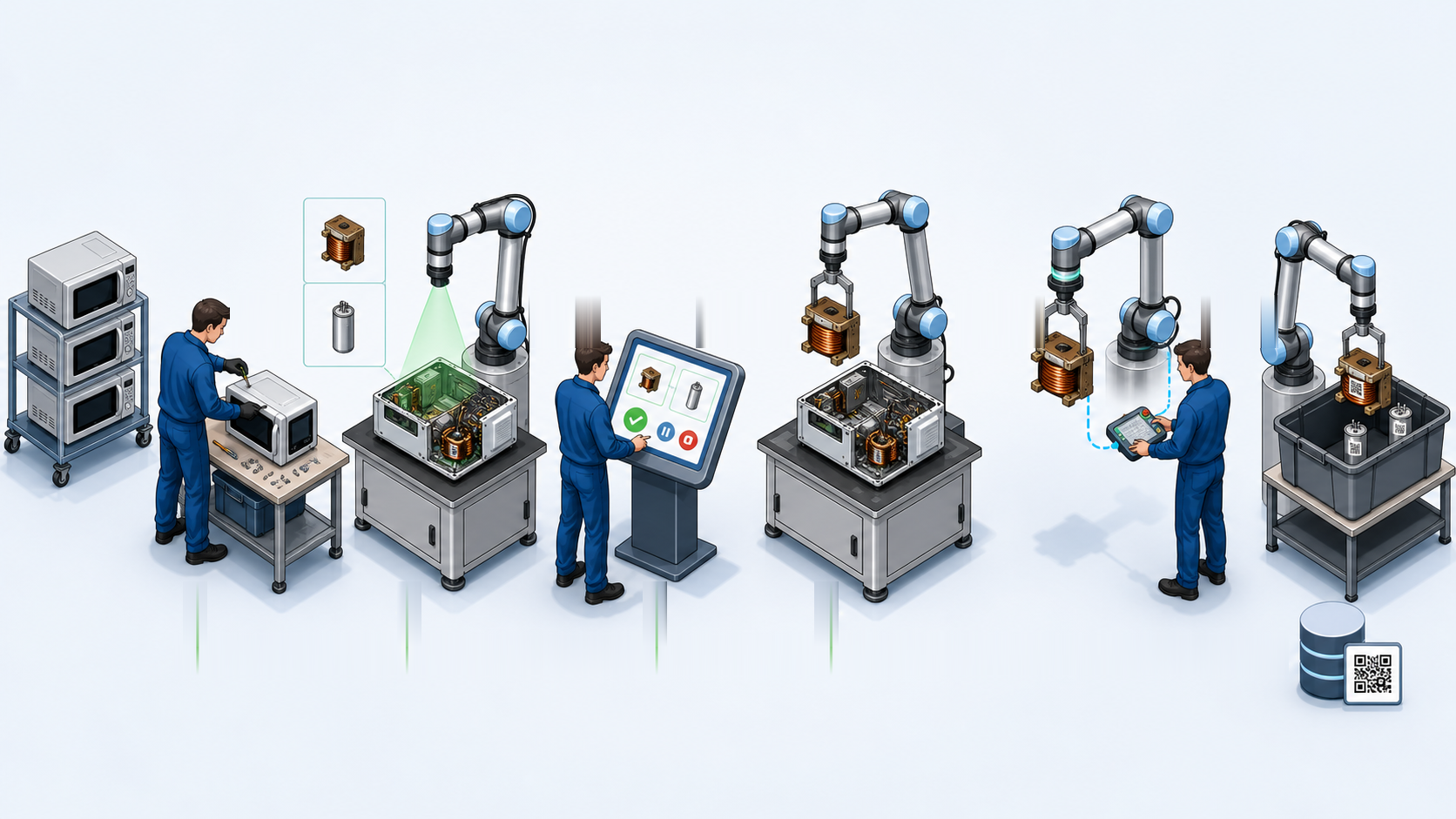
The line at a glance — the robot takes the extractions, the operator confirms each step, and every part is logged to the traceability database.
The challenge
Europe's e-waste volumes keep growing, and dismantling waste electrical and electronic equipment (WEEE) is exactly the kind of work automation was always supposed to take over — and never could.
- 01
Every unit is different. Brand, model, size and damage state change from one appliance to the next, defeating fixed automation and classical machine vision.
- 02
The work is hazardous. High-voltage capacitors, heavy transformers, sharp edges and repetitive strain make dismantling stations hard on people — and hard to staff.
- 03
Throughput is inconsistent, and almost no usable data comes off the line: no per-unit traceability, no reliable KPIs.
A cell built around the operator
Rather than chasing full autonomy, we built the cell around the person running it. A collaborative robot takes on the hazardous steps — locating and extracting high-voltage capacitors and heavy components — guided by vision based on generative pose estimation, which can locate parts it has never seen in that exact brand, position or damage state.
The operator supervises through three control modes — full autonomy, shared control, and direct teleoperation with safety assist — and can step in at any moment. Adaptive safety compliant with ISO/TS 15066 lets human and robot work in the same space without cages. The cell continuously adapts the robot's speed and path to the operator's position. All AI runs on edge hardware inside the facility: fast enough for safety-rated interaction, with no production data leaving the site.
The results
Validated in production conditions at a SUEZ facility in France.
Measured on the line: hazardous manual contacts fell by 53%, cold-start setup time dropped by 48–51%, every dismantled unit carries operator-verified traceability, and 80% of operators approved the system in structured evaluation.

Developed with SUEZ within the EARTH pilot of the JARVIS programme — jarvis-project.eu
The EARTH pilot received funding from the European Union's Horizon Europe research and innovation programme (Grant Agreement No 101135708).
Have a process everyone said couldn't be automated?
Book a demo and walk through how an adaptive human-robot cell would fit your line.