Skip to main contentSkip to footer

AI Employee · Robotic arms & manipulation

Measured in production conditions

Dismantling Operator

The robot takes the dangerous steps. The operator stays in command. Hired at a SUEZ facility in France in 2025, on a WEEE line where no two units are alike.

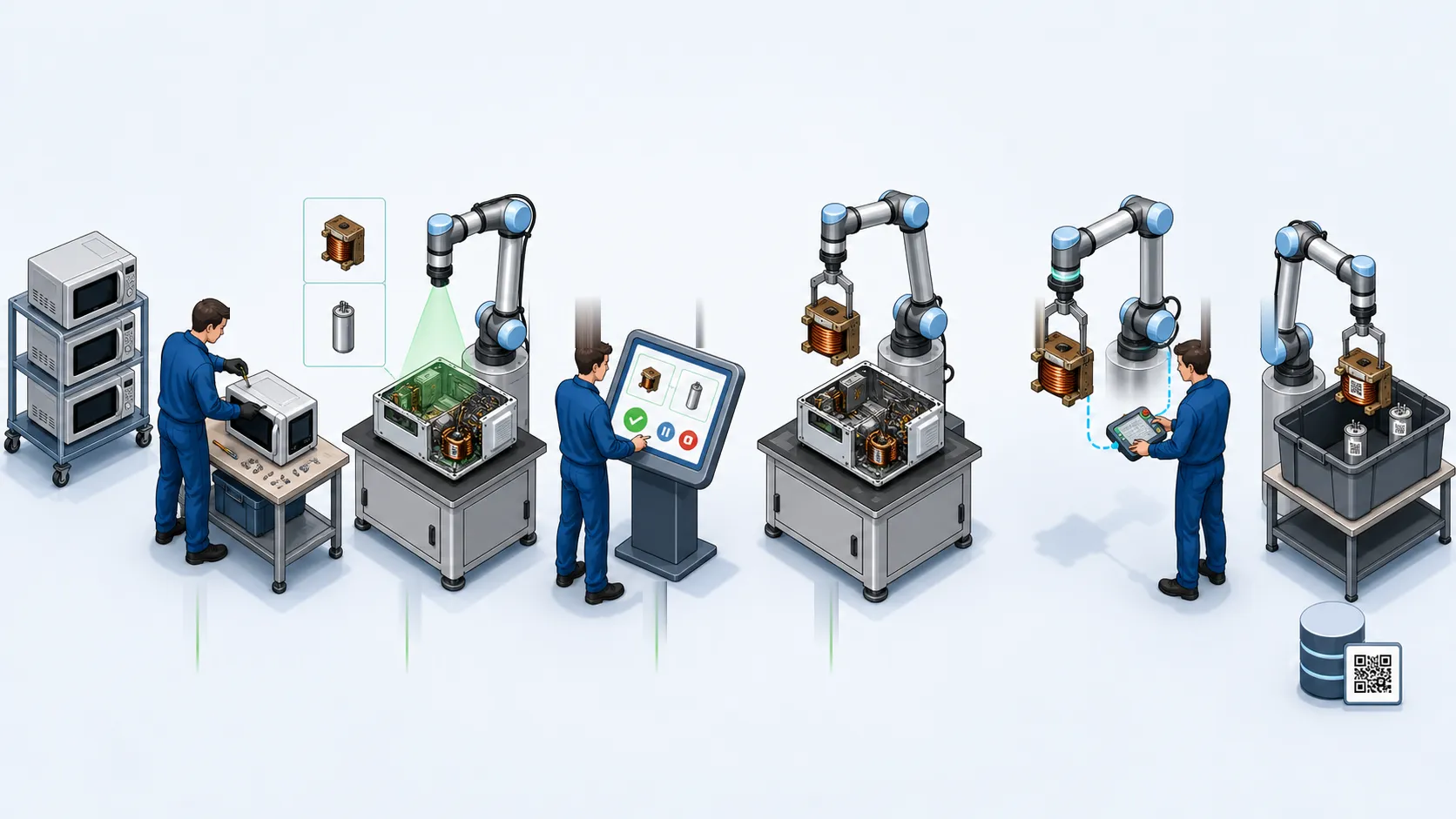
Illustrated overview of the human-robot dismantling line: six stations from intake to traceable deposit.

The line at a glance — the robot takes the extractions, the operator confirms each step, and every part is logged to the traceability database.

Employer
SUEZ
Site
A SUEZ facility in France
Since
2025
Body
Robotic arm
Mind
Ultrathink

The job

Europe’s WEEE volumes keep growing, and dismantling waste electrical and electronic equipment is exactly the kind of work automation was always supposed to take over — and never could.

  • 01

    Every unit is different. Brand, model, size and damage state change from one appliance to the next, defeating fixed automation and classical machine vision.

  • 02

    The work is hazardous. High-voltage capacitors, heavy transformers, sharp edges and repetitive strain make dismantling stations hard on people — and hard to staff.

  • 03

    Throughput is inconsistent, and almost no usable data comes off the line: no per-unit traceability, no reliable KPIs.

Three capabilities, one employee

What it does

Each capability was built and put on the line in its own programme. Together they are one worker: it extracts, it learns, it decides.

01Measured in production conditions

Takes the hazardous extractions

End-of-life appliances are dismantled by hand — hazardous, repetitive work on units that vary from one appliance to the next. This employee takes over the dangerous steps: locating and extracting high-voltage capacitors and heavy components, on a line where no two units are alike.

  • Vision that locates parts it has never seen in that exact brand, position or damage state.
  • Three control modes, from full autonomy to direct teleoperation — the operator chooses, the employee executes.
  • Cage-free operation compliant with ISO/TS 15066: speed and path continuously adapt to where people are.

First product family: microwave ovens.
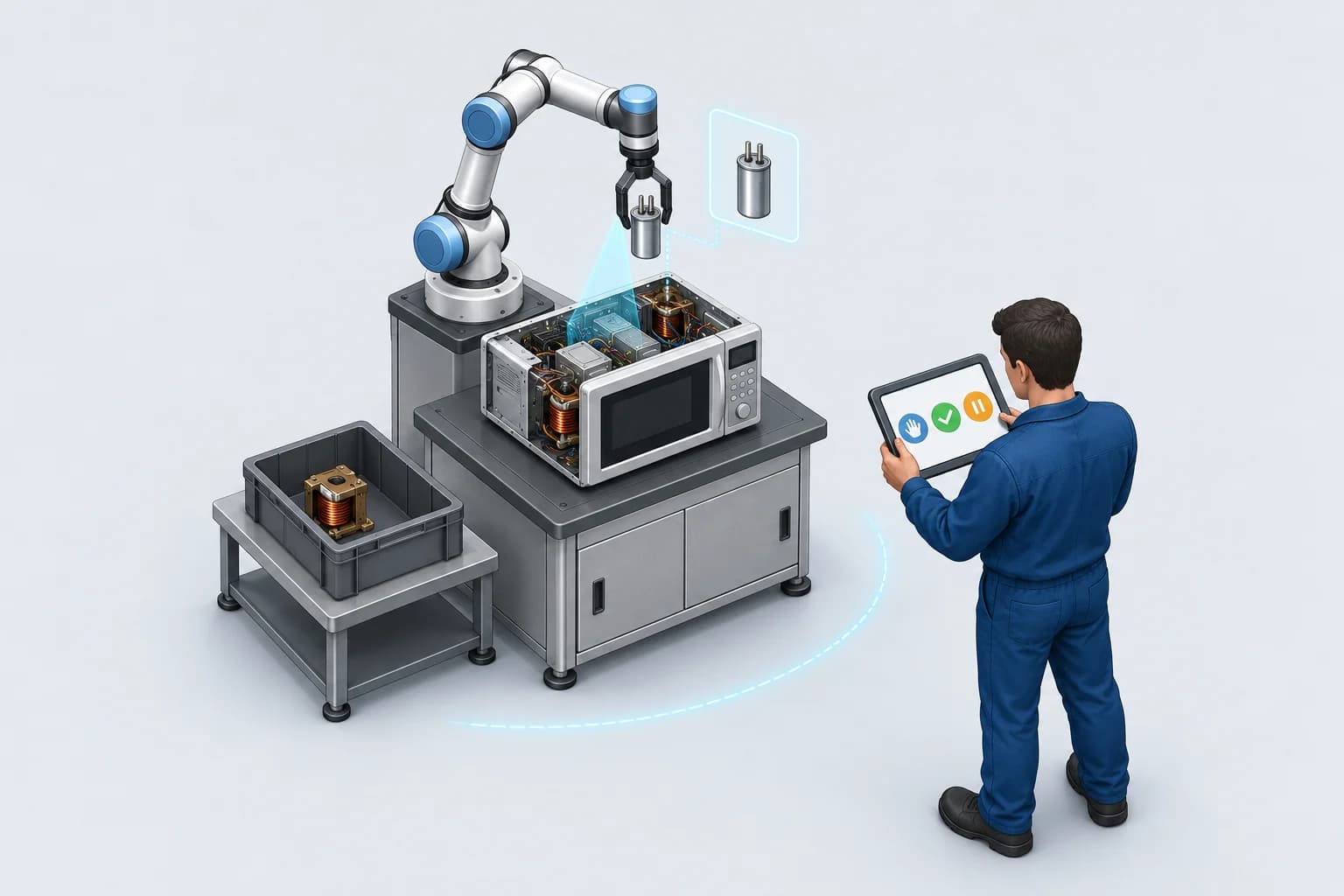
A robot arm lifts a high-voltage capacitor out of an opened microwave oven while the operator supervises from a tablet at a safe distance.

Developed within the EARTH pilot · JARVIS programme
02Active on site

Learns new tasks from your operators

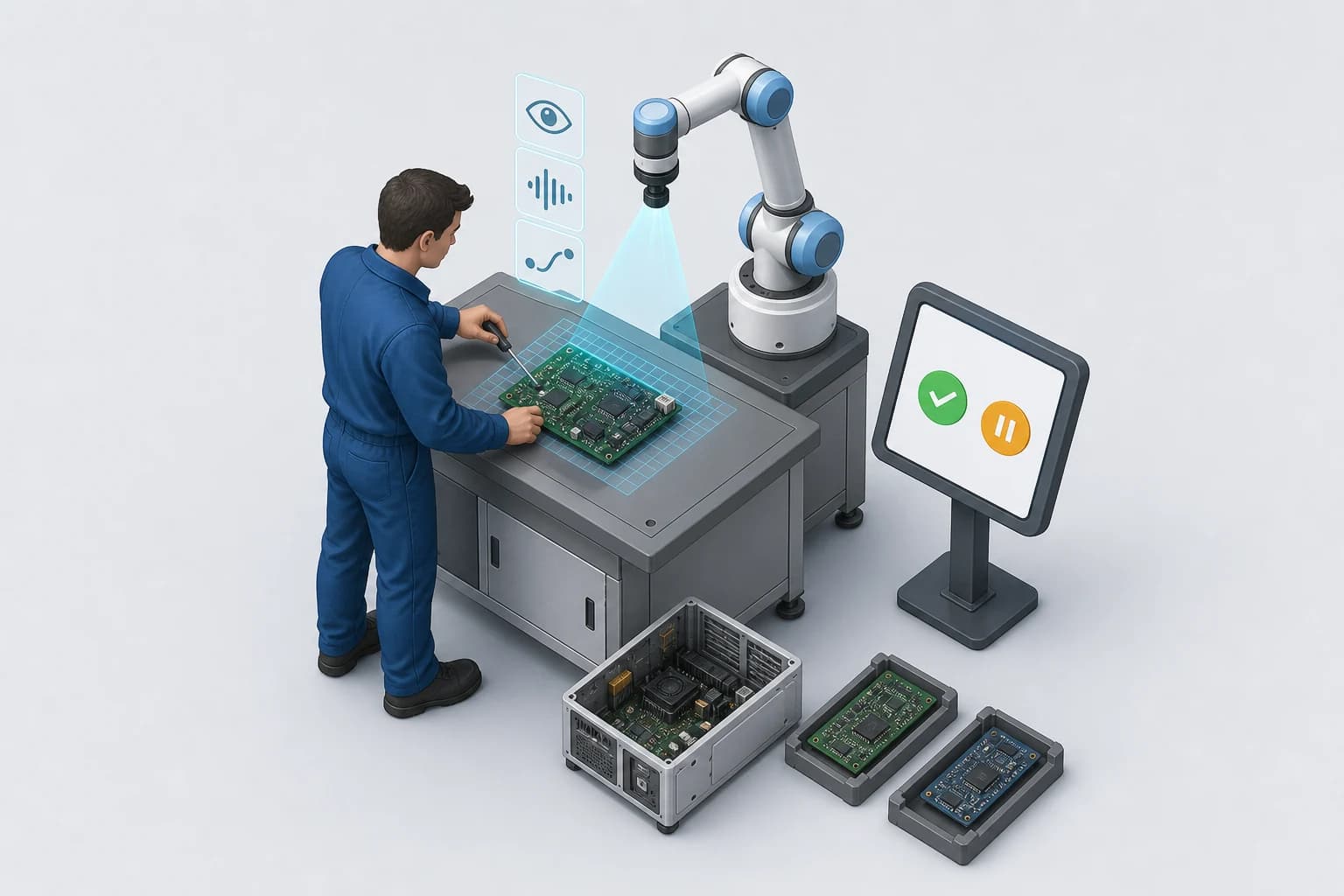
On high-mix lines, tasks change faster than robots can be reprogrammed. It watches an experienced operator demonstrate a task, turns it into a recorded task, and executes it only after a person has approved it.

  • Records the demonstration on the line — vision, sound and motion.
  • Every learned skill passes a human validation gate before it is released.
  • Executes under supervision, on the same shared-control base as the extraction work.

Current assignment: memory modules on computer motherboards.

An operator demonstrates a motherboard task while a robot arm records the demonstration.

Developed within MENTOR · ARISE programme

03Active on site

Decides which components are worth recovering

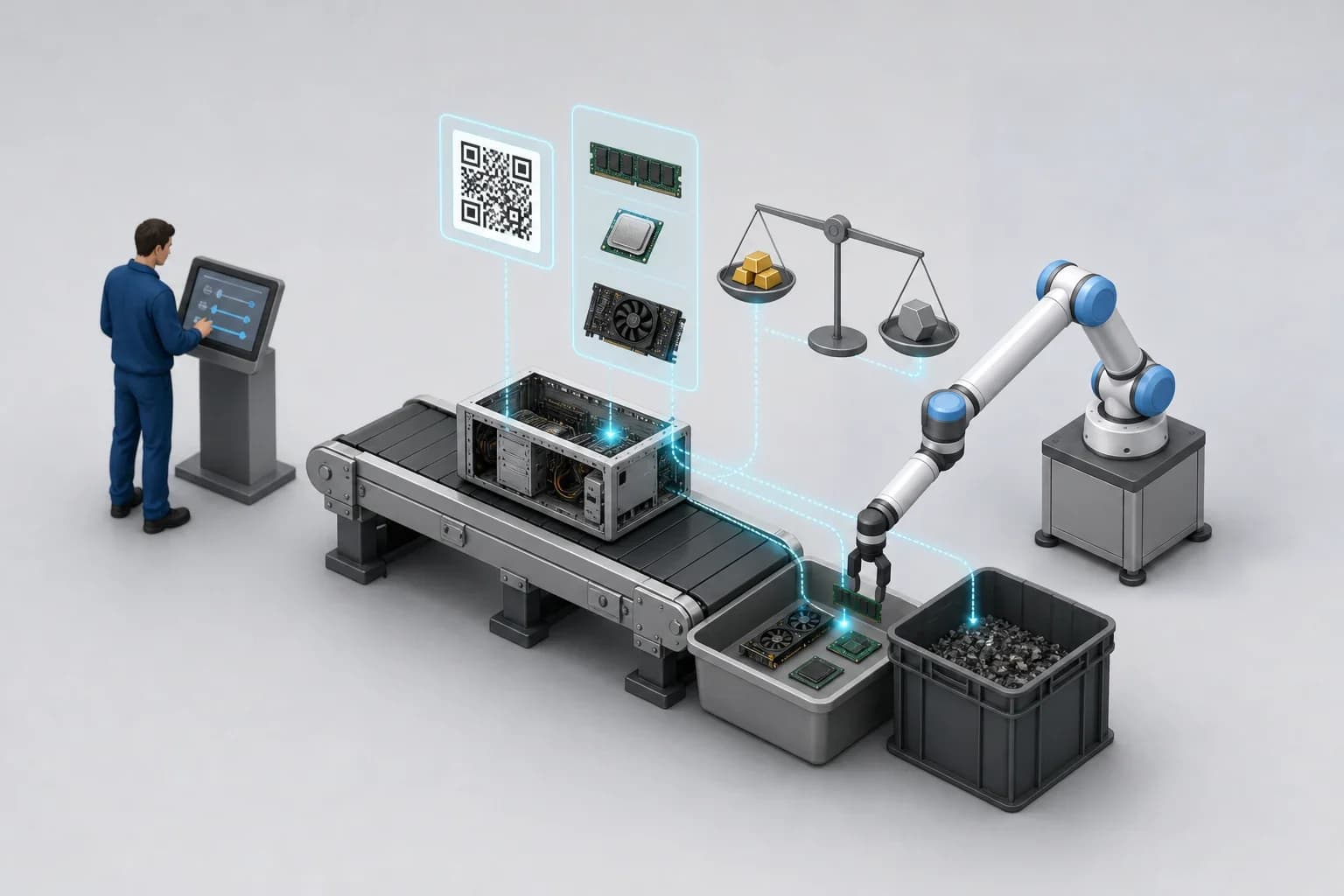
Most end-of-life electronics are processed for bulk material weight — reusable components are destroyed with the scrap. It weighs the value of every component before deciding what gets carefully extracted and what goes to recycling.

  • Reads digital product passports and inspects each unit to identify components and their condition.
  • Weighs live market value against extraction cost, per component, in real time.
  • Directs the robots, then writes the result back to the product passport for traceability.

Current assignment: end-of-life computers — processors, memory and, where worthwhile, graphics cards.

It decides within limits your team sets, and every decision is recorded for review.

A decision layer over an end-of-life computer: product passport, component value, recover or recycle.

Developed within CIRCULAI · ROB4GREEN programme

People stay in command

The operator supervises through three control modes — full autonomy, shared control, and direct teleoperation with safety assist — and can step in at any moment. Adaptive safety compliant with ISO/TS 15066 lets human and robot work in the same space without cages. The cell continuously adapts the robot's speed and path to the operator's position. All AI runs on edge hardware inside the facility, with no production data leaving the site.

Vision AI
generative pose estimation
Three control modes
full autonomy, shared control, direct teleoperation
ISO/TS 15066
adaptive safety, no cages

The results

Measured on the hazardous-extraction work, validated in production conditions at a SUEZ facility in France.

−53%
hazardous manual contacts
−50%
cell setup time
100%
operator-verified traceability
80%
of operators approved

Measured on the line, hazardous manual contacts fell by 53%. Cold-start setup time was cut in half. Every unit left the cell with operator-verified traceability, and in a structured evaluation 80% of operators approved the system.

The learning and recovery-value capabilities are active on the same line; their production metrics are not yet published.

The mind

Ultrathink — the patented mind of every AI employee. It perceives the situation, reasons about it, and decides the next action in real time.

How it is built →
JARVIS project logo

Developed with SUEZ within the EARTH pilot of the JARVIS programme — jarvis-project.eu

The EARTH pilot received funding from the European Union's Horizon Europe research and innovation programme (Grant Agreement No 101135708).

The learning and recovery-value capabilities were developed within the MENTOR (ARISE) and CIRCULAI (ROB4GREEN) programmes.

Have a station like this on your line?

Tell us about the station, the site or the decision that slows you down. We scope the position.

Describe your line